The Universal Idea
The Universal idea examined in two aspects: as Reflex Universal (the five Predicables — Species, Genus, Specific Difference, Property, Accident), and as Direct Universal (the ten Categories or Predicamentals).
The universal idea represents an essence predicable of many things in the same way — e.g. metal, virtue, man. Most of our ideas are Universals; even singular ideas are usually Universals narrowed by a qualifier like 'this.' Considered as a Reflex Universal (in its application to its inferior ideas), it yields the five Predicables — modes of predication, not classifications of things: Species (the complete essence defining the inferior, e.g. 'rational animal' of 'man'), Genus (the shared part of the essence, e.g. 'animal' of 'man'), Specific Difference (the distinguishing part, e.g. 'rational'), Property (a necessary but non-essential attribute, e.g. 'risible'), and Accident (a contingent attribute, e.g. 'reading being'). The Porphyrian Tree displays the subordination of Genera and Species graphically, from the highest genus (Substance) down through intermediate genera to the lowest species (man) and individuals. Considered as a Direct Universal, the universal idea corresponds to the ten Categories or Predicamentals — the supreme classes of understandable reality: substance and the nine accidents (quantity, quality, relation, place, posture, time, habit, action, passion), traditionally fixed in memory by a Latin mnemonic couplet.
Article 3. The Universal Idea
a) The Reflex Universal B) the Direct Universal
The universal idea, or, as it is often called, simply The Universal, is an idea that represents an essence which can be common to many things and is predrcable of each of these things in the same manner. Thus the idea metal represents an essence common to gold, silver, copper, lead, zinc, brass, aluminum, etc., and the idea can be predicated of all these together, and of each of them singly, in the same manner. All are metals; each is equally a metal. Thus also the idea virtue represents an essence common to honesty, purity, benevolence, charity, etc., and the idea can be predicated of all and each of these things in precisely the same manner: all come together in the class virtue, and each is equally a virtue. Thus again the idea man represents an essence common to Tom, Dick, Harry, Mary, Rose, Jane, etc., that is to say, an essence common to each and every human individual; and the idea is predicable of all mankind together, and of each human individual taken singly. Notice such predications in the following: “Man is mortal”; “John is a man.” The ideas metal, virtue, man are therefore Universals.
Most of our ideas are Universals. Even many singular ideas are Universals in themselves, but are made singular by the use of some qualifier like this. Thus the idea father is itself a Universal: it is predicable of all fathers (thus the Christmas ads say: “Gifts for father.”) and of each father. It is made singular by the use of qualifiers in “this father,” “my father,” etc.
The word universal is derived from the Latin unum versus alia (one in relation to other things). For the Universal is one, that is, it is a single idea in the mind and represents a single essence. But this essence may be found in a plurality of things other than the idea itself; and so the Universal stands representatively related to other things.
Now the “other things,” the things or objects that have the essence which is represented in the mind by the Universal, are called the subjects or the inferiors of the Universal. These inferiors are, first of all, ideas contained in the scope of the Universal. In a further sense, the inferiors are the extramental things represented by the Universal. Thus the Universal body is an idea that includes in its scope the ideas of living-body and non-living body inasmuch as these are bodies. The ideas living-body and nonliving body are Universals themselves, but they are lesser Universals than the greater Universal body. Hence these lesser Universals are inferiors of the greater Universal in which they are included. Here we see that when a Universal is applied to its inferior the process in an application or predication of idea to idea. This is, as we have learned, a reflex process. Therefore the Universal considered in applicability or predictability to its inferior ideas is called the Reflex Universal. In studying the Reflex Universal we ask: “In how many ways may a Universal be predicated of its inferior ideas?” In other words the question is: “In how many ways,—with what varying measure of exactness, necessity, completeness, or possibility,—may a Universal be predicated of its inferior ideas?”
We see from the above that the Reflex Universal is the Universal adverted to as such. But before the mind adverts to its Universal as such, it is already a Universal and can represent a plurality of things understandable, as they are in nature, apart from the consideration of the mind. In this aspect, the inferiors of the Universal are the extramental things which have the essence represented in the Universal. The Universal as a representation of these things is called the Direct Universal. In studying the Direct Universal we ask: “In how many classes do things (as understandable) exist in nature, apart from the consideration of the mind ?”
The Reflex Universal is, therefore, the Universal viewed in relation to its inferior ideas. The Direct Universal is the Universal considered as directly representative of an essence which can be common to extramental things.
a) The Reflex Universal
“In what modes or ways may the Universal be predicated of its inferior ideas?” In five ways. These ways or modes are called The Five Predicables, or simply The Predicables. Aristotle called them Categoremata. The Predicables are the five ways in one or another of which every Universal is predicable of its inferiors. The Predicables are modes of predication, not classes of extramental reality. They are the following:
-
Species, When a Universal is predicable of its inferior as one and coextensive with it in content, as completely defining it, then the Universal is the Species of its inferior idea. Thus the Universal rational animal is the Species of its inferior idea man. In the predication, “Man is a rational animal,” the Universal rational animal completely defines the essence man. If you represent these Universals (viz., rational animal and man) by concentric circles, the circumferences will fall exactly one upon the other; the circles will coincide.
-
Genus. When a Universal is predicable of its inferior idea as defining that part of its essence which it has in common with another Species, then the Universal is the Genus of its inferior idea. Thus the Universal animal is the Genus of its inferior idea man. In the predication, “Man is an animal,” the Universal animal defines that part of the essence of its inferior man which man has in common with another Species contained in the scope of animal, viz., brute. If you draw a circle to represent the Universal animal and another to represent man, the circles will overlap in part. The field of their overlapping will indicate the Genus of the two Universals (inferiors of animal), rational animal and non-rational animal, or simply man and brute. A Genus always includes two Species, not completely, but according to their common part. In their parts which are not common these will be contradictories, and so will exhaust the possibilities; thus there will only be two.
-
Specific Difference. The common part of the two Species included under any Universal is their Genus. The part which is not common is their respective Specific Difference, viz., that by which Species is distinguished from Species under a common Genus. Therefore, when a Universal is predicate of its inferior idea as defining that part of its essence (or Species) by which it is distinguished from the other Species of the same Genus, the Universal is the Specific Difference of its inferior idea. Thus the Universal rational (i. e., rational being) is the Specific Difference of its inferior man. In the predication, “Man is rational,” the Universal rational defines that part of the essence (or Species) of its inferior man which marks it off as distinct from the other Species with which it has a common Genus, viz., non-rational animal. In the circles just drawn to illustrate Genus, the overlapping area may be marked “animal” to indicate the Genus. Then the non-overlapping areas may be marked “rational” on the one hand, and “non-rational” on the other to indicate the respective Specific Difference of rational animal and irrational animal, that is, man and brute. Notice here that Genus plus Specific Difference gives the complete essence or Species.
-
Attribrite or Property. When a Universal is predicable of its inferior idea as defining no part of its Species or essence but as indicating something that belongs by natural necessity to that essence, then the Universal is the Property or Attribute of its inferior idea. Thus the Universal risible (that is, risible being, being that can laugh) is the Attribute of its inferior man. In the predication, “Man is risible,” the Universal risible defines no part of the Species or essence man, but indicates something that man (when his nature is fully and integrally constituted) must have by natural necessity.
-
Accident. When a Universal is predicable of its inferior idea as defining no part of its Species (or essence) and as belonging to it by no natural necessity, but simply as happening to belong to it, or as being capable of belonging to it, then the Universal is the Accident of its inferior idea. The Accident indicates what may be or may not be present to the inferior idea. Thus the Universal reading being is the Accident of its inferior man. In the predication, “Man is a reading being,” the Universal reading being defines no part of the Species or essence man; nor does it indicate something which belongs to that Species or essence by natural necessity; it merely indicates what may happen to be predicable of its inferior, what may or may not be present to its inferior.
The Predicables are to be studied with the closest attention and application until they are thoroughly and ineradicably impressed upon understanding and memory. In studying them the pupil must keep constantly in mind the cardinal principle: The Predicates are not classifications of things; they are modes of predication, modes according to which the mind applies idea to inferior idea. Of course, the process is not a mere arbitrary one; for the ideas do represent real essences, and the Universal is verified in each and every one of the extramental realities that have the essence which it represents.
An important matter to be studied after mastering the Predicates, is the so-called “Subordination of Genera and Species?’ This is graphically expressed in a scheme called the Porphyrian Tree, a drawing first made by Porphyry, a philosopher of the third century. We reproduce it here:
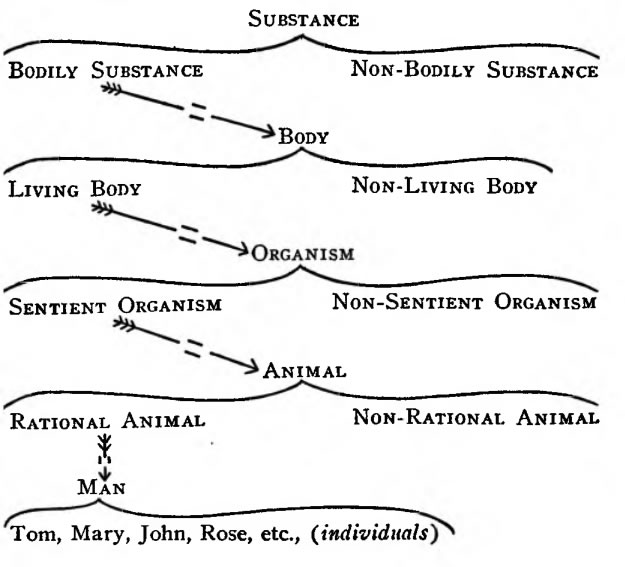
The Porphyrian Tree shows how a Universal may be a Genus with respect to its inferiors, and at the same time a Species with respect to a higher Genus.
Study the tree well. Notice the following points:
- Substance is called the highest genus, for it is not itself a species of a higher genus. All the other genera (body, organism, animal) are themselves species of higher genera. Body and organism are intermediate genera, having genera above and below them. Animal is the lowest genus, for it contains species which are not themselves genera of further species.
2. Corporeal substance and non-corporeal substance are called the highest species, for there is no species in a higher order. Rational animal (or man) is the lowest species for it is not in turn a genus of its inferiors, but is predicable only of individuals. All other species are intermediate species, since they have species above and below them, or, in other words, since each of them is a species of one genus, and in turn a genus of yet lower species.
-
Each genus considered in reference to the species immediately contained in it is called the Proximate Genus; other genera, higher up the “tree” than the Proximate Genus, are called Remote Genera. Thus organism is the Proximate Genus of sentient organism and non~sentient organism, but is the Remote Genus of man.
-
The lists on the right and left hand, that is, the “branches” of the tree on either side of the trunk, indicate Specific Difference. Notice that each species is constituted by Proximate Genus plus Specific Difference. Thus the species living body (or organism) is constituted by the Proximate Genus body plus the Specific Difference living.
-
Each genus (except the highest) is itself a species of a higher genus. Each species (except the lowest) becomes in turn a genus of a lower species.
b) The Direct Universal
“In what classes do things, as understandable, exist in nature?” In ten classes or Predicamentals. Aristotle called them The Categories. The Predicamentals are substance, and nine accidents.
substance is a being, bodily or spiritual, that is fitted for existence in its own right, not merely as a determination or qualifier of something else. Examples of substance: animal, man, body, soul, spirit, God, hill, tree.
accident is a being that is not fitted for existence in its own right, but regularly requires a substrate or subject in which to inhere. Action, for example, is a predicamental accident: we do not find action in bulk, so to speak, or independently existing, but only in an acting thing. Color is another example of accident; it is a quality; and color is not a thing fitted for independent existence but only as the determination or qualifier of a body.
There are nine accidents and only nine. Anything that can be conceived of as existing must be conceived as a substance or as one of the nine accidents. We shall list the accidents in a moment. Here we offer a reminder and a warning: the predicamental accidents are classes of understandable reality; the other Accident that we have learned about in the last few pages, that is to say the predicable Accident, is quite a different matter. The predicable Accident is not a classification of understandable reality; it is a mode of applying a Universal to its inferiors. Let the student make sure that he understands quite clearly the difference between the Predicamental Accident which is here studied in its nine branches, and the Predicable Accident which he has learned as a mode of predication in the mind.
The predicamental accidents are:
1. Quantity: the Spatial Extension of Bodily Sub
stance.
2. Quality: Determination of the Character of a
substance, bodily or spiritual:
i. dispositions or habits, such as prudence
or health;
ii. capacity or lack of it, such as rationality
or blindness;
iii. determination of passive character, such
as a color, temperature, age.
iv. bodily outline or figure, such as round
ness, angularity.
-
Relation: the order or standing of one thing with reference to another, such as likeness or unlikeness, identity or difference, paternity, servitude.
-
Place: position in reference to surrounding space. Place is indicated in such expressions as, in the street, at Rome, on the housetops, in the corner.
-
Posture: position in reference to parts of the same body. Posture is indicated in such expressions as, standing, sitting, lying down, huddled up, lolling, outstretched, sprawled out.
-
Time: position with reference to past, present, or future events. Time is indicated in such expressions as, at two o’clock, in the evening, after the ball, in five minutes, to-day, before noon.
-
Habit: determination of externals such as dress, equipment. Habit is indicated in such expressions as, armed, dressed, well caparisoned. (N. B. Habit of mind or soul or body—like studiousness, virtue, health—is Quality.)
-
Action: the production of change, the affecting of an object. Action is indicated in expressions like, heating, striking, wounding. 9. Passion: the receiving or suffering of change, being affected. Passion is indicated in expressions like, being heated, being struck, being wounded.
There is an ancient Latin couplet,—used to exemplify the Predicamentals or Categories and at the same time to fix them in memory,—which may be loosely translated as follows:
The tree cools the six slaves worn out by summer’s heat;
To-morrow I’ll stand in the country in garments clean and neat.
Notice the manner in which the couplet exemplifies the Predicamentals:
| Word in couplet | Predicamental |
|---|---|
| tree | Substance |
| cools | Action |
| six | Quantity |
| slaves | Relation (indicates reference to master) |
| worn out | Passion |
| heat | Quality |
| to-morrow | Time |
| I’ll stand | Posture |
| in the country | Place |
| in garments, etc. | Habit |
tree: Substance
cools: Action
six: Quantity
slaves: Relation (indicates reference to master) worn out: Passion
heat: Quality
to-morrow: Time
I’ll stand: Posture
in the country: Place
in garments, etc.: Habit
Summary of the Article
We have defined the Universal and learned what is meant by its inferiors. We have viewed the Universal in its reflex and direct aspects.
We have seen that the Reflex Universal is predicate of its inferiors as their Genus, Species, Specific Difference, Property or Attribute, or Accident. We have learned that these modes of predication are called Predicables or Categoremata.
We have studied the classification of things as they are in nature with reference to the understanding of the mind. We have thus learned that the mind grasps objective reality either as substance or as one of the nine accidents. These ten classifications of understandable reality we have learned to call The Predicamentals or The Categories.