Classification of the Idea
Ideas classified by five aspects: their origin (intuitive or derivative), perfection (clear, distinct, complete), comprehension (simple/compound, concrete/abstract), extension (singular, universal, particular, transcendental), and mutual relations.
Ideas are classified by five bases. By origin: intuitive (formed directly from sensation) or derivative (formed from intuitive ideas, including by arbitrary synthesis, e.g. a golden mountain). By perfection: clear (discernible from all other objects) or obscure; distinct (internal notes distinguishable) or vague; complete (all essential notes enumerable) or incomplete. By comprehension: simple or compound; concrete (representing a subject with its determinant) or abstract (the determinant alone, separated from its subject). By extension: singular (one object), universal (predicable of many), particular (a universal taken partially), or transcendental (exceeding all categorical limits — being). The collective idea (army, jury, family) is distinguished from the universal: it signifies a number of individuals taken as a unit, not an essence common to each. By mutual relations: identical (formally or materially) or different; associable (congruous) or opposed — by contrariety, contradiction, relation, or privation.
Article 2. Classification of the Idea
This Article groups or classifies ideas according to various aspects in which ideas may be viewed. These aspects,—the bases of our classification,—are as follows:
a) Origin
b) Perfection in Representing
c) Comprehension
d) Extension
e) Relations
a) Origin (intuitive-Derivative)
-
Intuitive ideas are those which originate in the direct grasp of that which they represent. Such are the ideas that are formed immediately upon sensation. Thus the ideas of sensible things, and the ideas one forms of one’s own feelings (and even thoughts) are intuitive ideas.
-
Derivative ideas are derived from intuitive ideas. Such are the ideas of supersensible things like soul, spirit, God, unity, truth. Such also are the ideas that originate in arbitrary synthesis of intuitive ideas—ideas like a sea of fire, a golden mountain, a talking tree.
b) Perfection {clear-Obscure; Distinct-Vague_;
com plete-inco mplete)
-
An idea which represents its object as discernible from all other objects is clear; otherwise it is obscure. If, for instance, I know the circle merely as a plane figure, I have some sort of idea of it (for the circle is a plane figure) but my idea is obscure, because the circle as a plane figure is not discernible from the triangle, the quadrilateral, etc. When I come to know the circle as discernible from all other plane figures, mj, idea ceases to be obscure and becomes clear.
-
A clear idea that presents its object in such wise that the more important essential notes are distinguishable one from another is distinct; otherwise it is vague or confused. If, for example, I am able to distinguish what the circle is in itself as well as to know it from other plane figures, my idea of the circle is clear and distinct; if, however, I merely know it as discernible from other plane figures, without being able to give any sort of definition of it in itself, my idea of the circle is clear but vague.
-
When an idea is so perfectly distinct that all its essential notes can be distinguished and enumerated, the idea is complete; otherwise, although clear and distinct, it is incomplete. If, for example, I know that man is a rational animal, my idea is distinct; but it is not complete unless I can enumerate the essential notes comprised in the idea animal (viz., bodily, living, sentient substance).
c) Comprehension (simple-Compound; Concrete
abstract)
-
Ideas that have but one note in their comprehension are simple; ideas that have more than one such note are compound. The idea of being (and its synonyms and equivalents) is simple. The idea of man—although it represents a single essence—is compound, for it has six essential notes in its Comprehension, as we have already seen.
-
An idea that represents something as a substrate or subject together with its determinant is concrete; an idea that represents a determinant as separated from a subject is abstract. The idea man is concrete, for it represents some thing with the determinant humanity. The idea humanity is abstract, for it represents a determinant apart from its subject. Examples of the concrete idea: body, spirit, object, white horse, pious man. Examples of the abstract idea: bodiliness, objectivity, whiteness, piety.
d) Extension (singular, Universal, Particular_,
transcendental)
-
An idea that has only one object in its Extension is singular. Such are the ideas of this circle, my father, Herbert Hoover, Pittsburgh, Ohio.
-
An idea which represents an essence that many objects may have is universal. Such are the ideas of circle, father, president, city, state.
-
A universal idea taken partially and indeterminately is particular. Such are the ideas of some circles, many fathers, certain presidents, a few cities, numerous states.
-
An idea that is so general or universal that it transcends the bounds of class and applies to all classes and individuals (though not in precisely the same manner and sense to each) is transcendental. Such an idea is that of being.
Notice that the universal idea differs from the collective idea. A collective idea signifies a number of individuals taken as a rimt, but does not represent an essence common to the individuals, but only to the units. Thus the ideas of army, jury, family, committee, etc., are collective ideas. The collective idea may be singular (as, this army), universal (as, all juries), or particular (as, some families).
The universal idea is a subject of supreme importance in Dialectics. We devote to its study the next Article of this Chapter.
e) Relations {identical-Different; Associableop
posed)
-
Ideas that have the same Comprehension or Extension are identical. Those that have the same Comprehension are formally identical. Such are the ideas man and rational animal. Ideas that have the same Extension are materially identical. Such are the ideas John Brown and this sealot, or Herbert Hoover and our president. Non-identical ideas are different.
-
Different ideas that are not mutually exclusive and may be harmoniously joined or compounded in the same idea are associable or congruous. Such are the ideas living and sentient. Ideas that are not associable are repugnant or opposed.
i. Two opposed ideas are contrary when they exclude each other but leave a ground between them; they do not exhaust the possibilities. Thus the ideas black and white are contrary ideas. They exclude each other but do not exhaust the possibilities, for there are many things neither black nor white.
ii. Two opposed ideas are contradictory when they exclude each other and leave no common ground between them; they exhaust the possibilities. Such are the ideas •white and not-white. They exhaust the possibilities, for there is nothing conceivable which is neither white nor not-white.
iii. Two opposed ideas are relative when one implies the other as a different object. Thus the ideas parent and child are relative. The idea parent involves the idea child, but indicates that the object which is parent is not at the same time child, John cannot be at once the parent and the child of George. The idea involved in another is an implicit idea. Thus we say that the idea child is involved in the idea parent, and parent is the explicit idea while child is an implicit idea. Conversely, considering the idea child directly (explicitly) we find implicit in it the idea parent. Examples of ideas between which the opposition of relation exists; husband-wife; superior-inferior; ruler-subject.
iv. Between two opposed ideas there exists the opposition called privation when one is the idea of a perfection that should be present in a given subject, and the other is a negation or denial of that perfection. Thus between the ideas sight and blindness (when used with reference to man, for example) there exists the opposition called privation. The idea which negatives or denies the perfection is called privative. Such an idea is merely negative, and not privative, when it denotes the absence of a perfection in a subject that could not have that perfection in any case. Thus blindness used with reference to a stone is negative but not privative.
Summary of the Article
In this Article we have learned to classify ideas as follows:
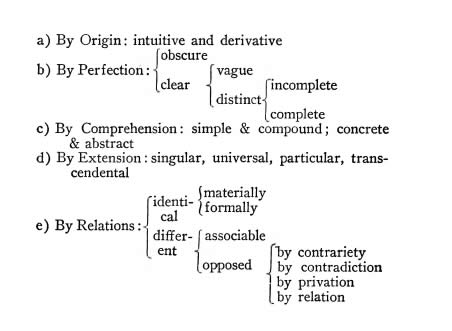
a) By Origin: Intuitive and Derivative
b) By Perfection: Vague
clear incomplete
distinct
complete
c) By Comprehension: Simple & Compound; Concrete
& abstract
d) By Extension: Singular, Universal, Particular, Trans
cendental
J materially
Tdenti-
£ formally
cal
e) By Relations: -
differ- ' associable
ent 'by contrariety
opposed by contradiction
by privation
.by relation