Figures and Moods of the Syllogism
The four Figures of the syllogism, determined by the position of the middle term, with their special laws; and the Moods of the syllogism, the valid arrangements of A, E, I, O propositions, sifted down from sixty-four possibilities to nineteen valid moods distributed across the figures.
The Figure of a syllogism is fixed by where the middle term falls in the premisses: Figure I (subject of first premiss, predicate of second) is the most perfect, showing the consequence most clearly; Figure II (predicate of both); Figure III (subject of both); Figure IV (predicate of first, subject of second — an inversion of the First, and negligible). Each valuable figure carries its own derived law (e.g., Figure I requires a universal major premiss and an affirmative minor). The Mood of a syllogism is the arrangement of its three propositions by quantity and quality, denoted by their letters (e.g. AAA, EIO). Of the 64 mathematically possible three-letter arrangements, the general laws of the syllogism eliminate all but eleven valid moods; applying each figure's special laws further narrows these to nineteen valid mood-figure combinations in all (four in Figure I, four in Figure II, six in Figure III, five in Figure IV). The First Figure is most perfect, and other figures can be 'reduced' to it — a process this manual only describes in passing, leaving fuller treatment to the Appendix.
Article 3. Figures and Moods of the Syllogism
The position of the middle term in the premisses determines what is called the figure of the syllogism. The middle term can occupy the following positions:
subject of both premisses;
predicate of both premisses;
subject of first, predicate of second premiss;
predicate of first, subject of second premiss.
Thus there are Four Figures of the Syllogism. Arranging these according to their perfection (that is, the clarity with which they show the consequence of the argument), we determine the figures according to the position of the middle term in the premisses, as follows:
First Figure: middle term is subject of first
premiss, predicate of second;
Second Figure: middle term is predicate of
both premisses;
Third Figure: middle term is subject of both
premisses;
Fourth Figure: middle term is predicate of first
premiss, subject of second.
Taking S for the subject of the conclusion (minor term), and P for the predicate of the conclusion (major term), and M for the middle term, we may illustrate the Four Figures as follows:
| Fig. I | Fig. II | Fig. III | Fig. IV |
|---|---|---|---|
| M – P | P – M | M – P | P – M |
| S – M | S – M | M – S | M – S |
| S – P | S – P | S – P | S – P |
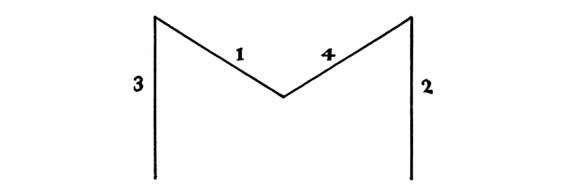
A good way of fixing the Figures in memory is to liken them to the four lines that make up the letter “M,” drawing the lines as indicated here:

The meaning of this mnemonic “M” is made clear in the following schema:
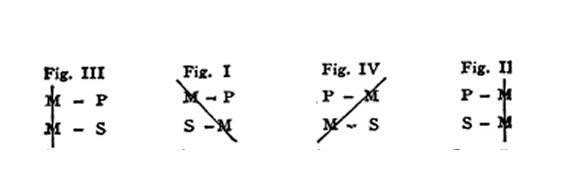
The most perfect Figure is the First. The Second and Third are of value; the Fourth is negligible, being an inversion of the First.
The Laws for the Four Figures are derived from the eight general laws of the categorical syllogism which we studied in the last Article. Without pausing to explain the derivation we state the following particular laws for the three valuable Figures:
Figure I: The major premiss must be universal;
the minor must be affirmative.
Figure II: The major premiss must be universal;
one premiss must be negative.
Figure III: The minor premiss must be affirma
tive; the conclusion will be particular.
Let the student determine the Figure of the following syllogisms, and test them by the laws just given and by the Eight General Laws:
All men are rational
All men are animals
Therefore, some animals are rational.
Tedious tales tire Tommy
“Tom Thumb” is a tedious tale
Therefore, “Tom Thumb” tires Tommy.
All metals are heavier than water
Ivory is not heavier than water
Therefore, ivory is not a metal.
Some judges are unjust men
All judges have authority
Therefore, some unjust men have authority.
No creature is infinite
God is infinite
Therefore, God is not a creature.
b) Moods of the Syllogism
The state of a syllogism resulting from the arrangement of its propositions with respect to their quantity and quality is called its mood. Thus, for example, a syllogism may have three universal affirmative propositions, or, as we have learned to call them, “A-propositions,” like the following:
All animals are sentient
All men are animals
Therefore, all men are sentient;
and since all the propositions are A-propositions, the mood of this syllogism is indicated thus: “AAA.” Take another example:
Some soldiers are cowards
All cowards are despicable
Therefore, some soldiers are despicable.
It will be obvious to the student that this is an IAI syllogism in mood. Take a final example:
No animals are spirits
Some animals are rational
Therefore, some rational beings are not spirits.
Again, it is obvious that the mood of this syllogism is EIO.
Now there are, absolutely speaking, as many moods of the syllogism as there are arrangements of three propositions with respect to their quantity (extension of subject) and quality (affirmation or denial in the copula). In other words, there are four types of propositions (A, E, I, O) to be arranged in groups of three; and by the laws of mathematics we see that the possible arrangements total to four in the third power, that is, sixty-four. But fifty-two of these arrangements will be found to conflict with the laws of the syllogism, for they involve conclusion from negative premisses, general conclusion when unwarranted, conclusion from particular premisses, or negative conclusion from affirmative premisses. Casting out the fifty-two invalid moods, we have the following twelve:
AAA, AAI, AEE, (AEO), All, AGO,
IAI,
OAO.
Since AEO is contained in AEE (for O is subalternate of E) it may be omitted.
The Eleven Moods cannot all be used validly in all Four Figures, for the propositions of the syllogism must conform to the special laws of figures. The absolute number of valid moods would seem to be eleven times four, or forty-four, but the special laws of figures eliminate twenty-five of these, and there remain nineteen valid moods, of which
four are in the First Figure (AAA, EAE, All,
EIO)
four are in the Second Figure (EAE, AEE,
EIO, AOO)
six are in the Third Figure. (A Al, I Al, All,
EAO, OAO, EIO)
five are in the Fourth Figure (A Al, AEE, I Al,
EAO, EIO)
The First Figure, as we have said before, is the most perfect figure, for it shows most clearly the connection or consequence of the premisses and conclusion. For this reason Dialecticians have formulated an elaborate system of rules for the reduction of syllogisms to the First Figure. To “reduce” a syllogism to the First Figure, is to restate it in the shape of the First Figure. The reduction of syllogisms is an intricate process. Doubtless it is of great value as mental training for students that can master its complexities and spare time for the exercise. But, as Reinstadler says, its practical value is inconsiderable, and, to quote no less an authority than Lepidi, “if this matter (reduction of syllogisms) is found difficult for beginners, let it be omitted; their loss will not be great.” This manual of Dialectics offers here no more on the subject of reduction of syllogisms than a passing description of what it means. The subject is, however, discussed with some completeness in the Appendix.
Summary of the Article
In this Article we have learned what is meant by the Figures and the Moods of the Syllogism. We have studied the special laws—derivations from the Eight General Laws for Categorical Syllogisms—by which each Figure is regulated, and have seen these laws applied in several examples. We have sifted out the valid Moods of the syllogism from the number of possible arrangements of the premisses of the syllogism with respect to quality and quantity, and have assigned to each Figure the Moods that may occur in it validly. We have studied what is meant by “reduction” of syllogisms.