Laws of the Syllogism
The eight laws of correctness for the categorical syllogism (four Laws of Terms, four Laws of Propositions), each explained and justified, plus the laws governing the three types of hypothetical syllogism, with extensive worked examples and practice syllogisms for the student to test.
Eight laws govern the correct categorical syllogism, summed up in a mnemonic jingle. Four Laws of Terms: there must be exactly three terms (not four through equivocation); no term may be wider in the conclusion than in the premisses; the middle term must never appear in the conclusion; the middle term must be distributed at least once. Four Laws of Propositions: two affirmative premisses cannot yield a negative conclusion; two negative premisses yield no conclusion at all; the conclusion follows the weaker part (negative if one premiss is negative, particular if one premiss is particular) — each rigorously proved; and two particular premisses yield no conclusion. Each law is illustrated with correct and incorrect syllogisms, including many practice exercises for the student to test. The hypothetical syllogism has its own laws by type: the Conditional syllogism permits the 'put' method (affirming the antecedent) and the 'take' method (denying the consequent); the Conjunctive syllogism permits only 'put-take' (affirming one member, denying the other); the Disjunctive syllogism permits both 'take-put' and 'put-take,' provided the disjunction is genuinely exhaustive.
Article 2. Laws of the Syllogism
a) Laws for the Categorical Syllogism
b) Laws for the Hypothetical Syllogism
a) Laws for the Categorical Syllogism
Here we set forth and explain the eight general laws of correctness for the perfect categorical syllogism. Derivative laws for special application in the various figures of the syllogism will be discussed in the next Article.
We know that the syllogism has three terms and three propositions. The following laws are divided into two groups, the first being the “Laws of Terms,” and the second group being the “Laws of Propositions.”
Laws of Terms
Three terms there must be, neither more nor less,
No wider in Conclusion than in Premiss;
Conclusion never dares the Middle mention;
The Middle, once or twice, has full Extension.
Laws of Propositions
Affirmatives can never breed negation;
Two negatives end ever in frustration;
Conclusion follows e’er the weaker part;
Particulars no argument can start.
To explain these laws in detail:
i. Laws of Terms
First Law of Terms: Three terms there must be, neither more nor less. This law expresses a requirement of the very nature of the syllogism. For the syllogism is a process of reasoning to the agreement or disagreement of two terms through their relation to a third term. The syllogism exists for its conclusion; it is framed to reach the conclusion, to reason to the conclusion. Now the conclusion will express the relation (agreement or disagreement) of a subject and predicate. The predicate is the major term; the subject is the minor term. The third term, used only in reasoning to the conclusion, is compared in the premisses with the major and the minor term, and is called the middle term. Every perfect categorical syllogism must have, in consequence, a major, a minor, and a middle term. It must not have more than these, else the relation of major and minor term will not be apparent; for these must be studied in their relation to a common third term (the middle term) so that their relation to each other may be discerned thereby. Notice that three terms are required, not merely three names or words, A name or word might be used in two senses, and hence, while remaining the same word, would be two terms. To introduce such ambiguity or equivocation into the syllogism would cause it to violate this First Law of Terms, for, in the case supposed, there would be four terms and not three. An example of such equivocation is the following:
A bank is a place in which money is deposited
This mound of earth is a bank
Therefore this mound of earth is a place in
which money is deposited.
The term bank is one word, but is used in two utterly different “suppositions,” and hence the argument contains four terms and is no true syllogism. Let the student test the following by the First Law of terms:
Every man is God’s image
Judas was a man
Therefore, Judas was God’s image.
A wait is a short stop
A short-stop is a ball-player
Therefore, a wait is a ball-player.
No effect is causeless
This is an effect
Therefore, this is not causeless.
Second Law of Terms: No wider in Conclusion than in Premiss, That is to say: the terms must not have a larger Extension in the conclusion than they have in the premisses. If the terms should have a larger Extension in the conclusion than in the premisses, then the conclusion says more than the premisses warrant. Remember that the conclusion is only the explicit statement of what is implicitly contained in the premisses. How is one to judge of the Extension of the terms in the premisses? The subject of the premisses will always be universal or particular, and this will be indicated by qualifier or obvious sense; and the predicate of the premisses is judged by the two principles already learned, viz., i. The predicate of an affirmative proposition is undistributed (that is, is particular), and 2. The predicate of a negative proposition is distributed (that is, is universal or in full Extension). To illustrate:
Every tiger is a living being
A man is not a tiger
Therefore a man is not a living being.
Notice the following facts: living being in the premiss is particular—predicate of an affirmative proposition. But the same term in the conclusion is general or universal (in full Extension)—predicate of a negative proposition. Thus the conclusion says more than the premisses warrant, and the syllogism is incorrect because it violates the Second Law of Terms.
Let the student criticize the following in the light of the First and Second Law of Terms.
War is hell
Hell is a place
Therefore, war is a place.
A game is a play
A dramatic performance is not a game
Therefore, a dramatic performance is not a
p^y.
Brass is not precious metal
This ring is brass
Therefore, this ring is not precious metal
Gold is precious metal
This ring is not gold
Therefore, this ring is not precious metal
Third Law of Terms: Conclusion never dares the Middle mention. That is to say, the middle term, which occurs in both premisses, must never occur in the conclusion. The reason is obvious. The middle term is the medium used to reach the pronouncement which the mind seeks to make about the major arid the minor term. The conclusion is the one thing sought for; it is the sole reason for the existence of the syllogism; the mind knows its elements (subject and predicate—or, minor and major terms) from the start, and uses the middle term only to enable it to make pronouncement on the relation of these. Therefore, by the very nature of the syllogism, the middle term is the means of reaching the conclusion, but has no place in the conclusion. Should the middle term occur in the conclusion, the argument is vitiated and is no true syllogism. To illustrate:
John is lazy
John is a student
Therefore John is a lazy student.
This is merely the compounding of terms; it is not reasoning. The last statement merely combines the other two; it does not draw out a proposition latent in them. The last statement is only a more compact form of the other two statements. Let the student criticize the following in the light of the first three Laws of Terms:
Galahad was a knight
A night is dark
Therefore, Galahad was dark.
No cat has two tails
My dog is no cat
Therefore, my dog has two tails.
Bread is a staple food
Potatoes are a staple food
Therefore, bread and potatoes are staple foods.
Flattery is not good
Foolish praise is flattery
Therefore, foolish praise is not good.
Fourth Law of Terms: The Middle, once or twice, has full Extension. That is to say, the middle term, in at least one of the premisses, must be distributed. If it be taken in partial Extension in both instances, the premisses can only be two independent i3o DIALECTICS
statements without logical sequence, implying no conclusion. The following example makes the matter clear:
Wine is an intoxicant
Whiskey is an intoxicant
Therefore, whiskey is wine.
The middle term, an intoxicant, is undistributed in both premisses (being in each instance the predicate of an affirmative proposition). The premisses are seen to be independent statements. Draw a circle to indicate the Extension of the term intoxicant. Within the circle make two smaller circles, marking one wine and the other whiskey. Thus you perceive that, while the two statements (premisses) assign both whiskey and wine to the class intoxicant, they say nothing about the full relation of whiskey to wine. Hence the conclusion set down is altogether unwarranted. The argument is no syllogism; it offends against the Fourth Law of Terms.
Let the student criticize the following in the light of the four Laws of Terms:
Some birds sing melodiously
All ducks are birds
Therefore, all ducks sing melodiously.
All wars bring misery
A revolution is a war
Therefore, a revolution brings misery.
Some preternatural events are deceptions But this event is a preternatural event Therefore, this event is a deception.
Diogenes sought an honest man
An honest man is John Jones
Therefore, Diogenes sought John Jones.
All Caucasians have inviolable rights Negroes are not Caucasians
Therefore, negroes do not have inviolable
rights.
No earthly benefit is lasting
Filial love is an earthly benefit
Therefore, filial love is not lasting.
All typhus is dangerous
This disease is not typhus
Therefore, this disease is not dangerous.
Sam sings songs
Sam sings sweetly
Therefore, songs are sweetly sung by Sam.
No news is good news
All history is no news
Therefore, all history is good news.
Some airplanes are biplanes
That big monoplane is some airplane
Therefore, that big monoplane is a biplane.
ii. Laws of Propositions
First Law of Propositions: Affirmatives can never breed negation. That is to say, two affirmative premisses can never lead to a negative conclusion. In other words, if both premisses are affirmative, the conclusion will necessarily be affirmative. The conclusion expresses explicitly only what is implied in the premisses. Now, two affirmative premisses imply no negation whatever. Therefore no negation can be expressed in the conclusion.
Let the student criticize the following:
Oranges are a tropical fruit
Tropical fruits are expensive
Therefore, oranges are not cheap.
Second Law of Propositions: Two negatives end ever in frustration. That is to say, no conclusion can be drawn from two negative premisses. The syllogism by its nature requires the positive assertion of the relation of at least one of the extreme terms (that is, major and minor terms) to the middle term. If both premisses are negatives, they are independent denials, and nothing can be drawn from them about the relation of the major and minor term to each other. The following example makes this obvious:
Man is not a spirit
An angel is not a man
(no conclusion possible)
Nothing is said in these premisses to justify an inference concerning angel in relation to spirit. The result—for all the premisses tell us—might be what is illustrated in either of the following figures:
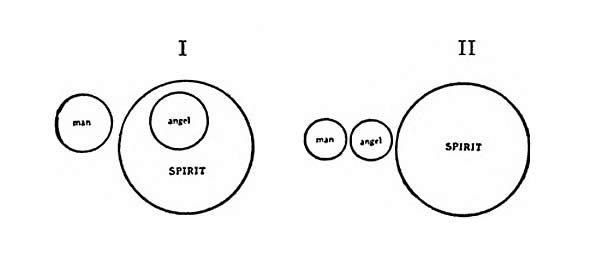
third law of propositions i Conclusion follows e’er the weaker part. This law requires a somewhat lengthy and involved justification. The student is asked to master each step in the argument before proceeding to the next.
By the “weaker part” we mean negation (in quality) and particularity (in quantity) as opposed to the “stronger part,” that is, affirmation and universality. The law means: “If one premiss is negative and the other affirmative, the conclusion will necessarily be negative; and if one premiss is particular and the other universal, the conclusion will necessarily be particular.”
-
If one premiss is negative and the other affirmative, the conclusion will be negative. The affirmative premiss will assert the agreement of one of the extremes (major and minor terms) with the middle term. The negative premiss will assert the disagreement of the other extreme with the middle term. Hence, the extremes will stand in disagreement with each other—and this means that the conclusion will be negative. To illustrate: Take A and B as the extreme terms, and C as the middle term. Let the affirmative premiss be “A is C.” Let the negative premiss be “B is not C.” There is no conclusion possible except “A is not B,”—a negative conclusion. Thus, “Conclusion follows e’er the weaker part.”
-
If one premiss is particular and the other universal, the conclusion will be particular. Here the possibilities are as follows: i. both premisses may be affirmative; or ii. one premiss may be affirmative and one negative. In either case the conclusion must be particular, as we see from the following:
i. If both premisses are affirmative, there will be only one universal term (that is, term taken in full Extension) in the premisses, viz., the subject of the universal premiss. Both being affirmative propositions, the two predicates will be undistributed, that is, particular; and the subject of the particular premiss will be particular: hence only the subject of the universal premiss can be universal. Now, this one universal term must be the middle term by the Fourth Law of Terms: “The Middle, once or twice, has full Extension.” Nor can this middle term appear in the conclusion, by the Third Law of Terms: “Conclusion never dares the Middle mention.” It follows, that there are no terms for the conclusion but particular terms. Hence the conclusion must be particular. Q.E.D.
ii. If one premiss is affirmative and the other negative, there will be only two universal terms in the premisses, viz., the subject of the universal premiss, and the predicate of the negative premiss. But for the conclusion to be universal, there would have to be three universal terms in the premisses. For in the present hypothesis the conclusion must be negative (as we have proved in the first part of the explanation of this law), and if this conclusion were universal it would involve two universal terms—the iz subject, because it would be the subject of a universal proposition; and the predicate, because it would be the predicate of a negative proposition. Now these terms could not be universal in the conclusion unless they were universal in the premisses, for the Second Law of Terms is: “No wider in Conclusion than in Premiss.” Hence the premisses would have to contain two universal terms for the conclusion; and, in addition, the premisses would have to contain the middle term in full Extension (i. e., universal) at least once. Therefore the premisses would have to contain three universal terms if the conclusion were to be universal. But, as stated above, the premisses do not contain three universal terms, but only two. Therefore the conclusion cannot be a universal proposition. It remains that it must be a particular proposition. Q.E.D.
Fourth Law of Propositions: Particulars no argument can start. That is to say, if both premisses are particular propositions, no conclusion is possible. Such premisses will necessarily be independent statements without strict logical connection. We may prove the law as follows:
I. If both premisses (particulars) are affirmative, they will contain no universal term whatever. Their subjects will both be particular terms, because they are subjects of particular propositions. And their predicates will both be particular terms, because they are predicates of affirmative propositions. Now the premisses of every real syllogism must contain at least one universal term for, “The Middle, once or twice, has full Extension.” Hence, from particular affirmative premisses we can conclude nothing, since there is no comparison of major or minor term with the middle term in full Extension.
-
If both premisses (particulars) are negative, no conclusion is possible by the Second Law of Propositions: “Two negatives end ever in frustration.”
-
If one particular premiss is affirmative and the other particular premiss is negative, then the conclusion will be negative, for “Conclusion follows e’er the weaker part.” This conclusion will require a universal term for its predicate, for “In a negative proposition, the predicate is distributed.” Hence, this universal term must occur in the premisses; and the middle term must also occur in the premisses as a universal at least once. Two universal terms must therefore occur in the premisses. But, as a matter of fact, in such premisses as we consider here, two universal terms cannot occur. Both premisses being particular propositions, it follows that only the predicate of the negative premiss can be a universal term. It is obvious, therefore, that no conclusion can be drawn from such premisses.
note: For compound categorical syllogisms, the general rule is as follows: Reduce the syllogism to the simple categorical syllogisms contained in it, and frame or criticize these according to the Eight Laws already explained. Ordinarily, however, the Eight Laws may be applied directly, without reduction if the student will be very careful to avoid the ever-present danger of saying more in the conclusion than the premisses warrant. Here, for example, is an unjustified inference which comes from ignoring this warning:
An infinitely perfect Being is eternal
God alone is an infinitely perfect Being
Therefore, God alone is eternal.
In the second (or minor) premiss, the force of the exclusive particle alone centers upon infinitely perfect Being. In the conclusion alone centers upon the term eternal. Thus the conclusion is unwarranted. In other words, the premisses say that God is the only infinitely perfect Being, but they do not say that only an infinitely perfect Being is eternal: yet the conclusion indicates that the premisses do say this, and hence the conclusion is unwarranted. This fact is shown in the following restatement of the syllogism:
An infinitely perfect Being is eternal (Maybe
other beings are too)
God alone is an infinitely perfect Being (No
other Being is infinitely perfect, but maybe
other beings are eternal)
Therefore, God is eternal (It must not be
stated, in view of the premisses, that no
other beings are eternal).
It appears then that the term alone in the second (or minor) premiss merely adds a bit of information which is alien to the general progress of the argument in hand. Leaving aside this alien matter, we have the syllogism as follows:
An infinitely perfect Being is eternal
God is an infinitely perfect Being
Therefore, God is eternal.
“God is eternal” is the only conclusion that can be justified.
Let the student grapple with the difficulties presented in the following syllogisms:
All diligent students will receive a prize
All but John are diligent students
Therefore, all but John will receive a prize.
Brute animals are not what men are
Men are rational
Therefore, brute animals are not rational.
We are not what brutes are
Brutes are animals
Therefore, we are not animals.
Everyone who says that Peter is baptized, says
the truth
Everyone who says that Peter is a Christian,
says Peter is baptized
Therefore, everyone who says that Peter is a
Christian, says the truth.
(Suggestion: There is such a thing as non-Christian baptism—that of St. John the Baptist, for instance.)
The king awards honors to all who serve the
state
John Johnson does not serve the state
Therefore the king does not award honors to
John Johnson.
b) Laws for the Hypothetical Syllogism
As we have seen, there are three types of hypothetical syllogisms, the conditional, the conjunctive, and the disjunctive. We deal with each of these singly.
i. The Conditional Syllogism. Law: From the truth of the antecedent follows the truth of the consequent, but not vice versa; and from the falsity of the consequent follows the falsity of the antecedent, but not vice versa. In other words:
if antecedent is true—consequent is true;
if antecedent is false—consequent is true or
false;
if consequent is true—antecedent is true or
false;
if consequent is false—antecedent is false.
From these four facts we deduce two “put and take” methods for forming the minor premiss of the conditional syllogism:
i. The “put”-method affirms the truth of the antecedent. Example:
If God is just, the soul will survive death God is just
Therefore, the soul will survive death.
ii. The “take”-method denies the truth of the consequent. Example:
If the soul does not survive death, God is cruel God is not cruel
Therefore, the soul survives death.
Notice here that we should violate the law of conditional syllogisms if we made the minor of the first syllogism, “The soul will survive death,” and then conclude, “Cod is just.” This would be concluding to the truth of the antecedent from the truth of the consequent, which is an unwarranted procedure. Nor, in the second example, could we put as minor premiss, “The soul survives death,” and conclude, “Therefore, God is not cruel.” This would be concluding to the falsity of the consequent from the falsity of the antecedent—an unjustified procedure.
- The Conjunctive Syllogism. Law: From the truth of one component follows the falsity of the other, but from the falsity of one component it does not follow that the other is true. In other words:
if one component is true—the other is false;
if one component is false—the other may be
true or false.
From these two facts we deduce the one method of reaching a conclusion in the conjunctive syllogism. It is the “put-take,” that is, one member of the conjunctive premiss is affirmed (“put”) in the minor premiss, and the other is denied (“take”) in the conclusion. Example:
Peter does not sit and stand at the same time
Peter stands (“put”)
Therefore Peter does not sit (“take”)
We could not use the “take-put” method and reach a conclusion, for the members of the conjunctive premiss (the major premiss) do not exhaust the possibilities, and hence to deny one is not to affirm the other. Thus the following syllogism is incorrect, and its conclusion unwarranted:
Peter does not sit and stand at the same time
But he is not sitting
Therefore he stands (He may be lying down!)
- The Disjunctive Syllogism. Law: From the truth of one member follows the falsity of all the others, and from the falsity of one member follows the truth of one of the others. In other words:
if one member of the disjunction is true—other
or others are false;
if one member of the disjunction is false—one
of the others is true.
From these two facts we deduce two methods of reaching a conclusion in the disjunctive syllogism. These are the “take-put” and the “put-take” methods. Examples:
Either it is day or it is night
It is not day (“take”)
Therefore, it is night (“put”)
Either it is day or it is night
It is night (“put”)
Therefore, it is not day (“take”)
The student must be sure that the major premiss is a complete disjunction, else he may (and probably will) reach an unjustified conclusion. The following example shows such a conclusion:
It is spring, summer, or autumn
It is not autumn
Therefore, it is spring or summer (It may be winter!)
Let the student criticize the following syllogisms in the light of the Laws for Hypothetical Syllogisms:
If it rains the game will be postponed
The game will be postponed
Therefore, it rains
If you are a fool, you will not study
You will not study
Therefore, you are a fool
If you are not a fool, you will study
You will study
Therefore, you are not a fool
If the ring is solid gold, I want it
The ring is not solid gold
Therefore, I do not want it
We do not have rain and fair weather simul
taneously
We have not fair weather to-day Therefore, we have rain to-day
John cannot be at once studious and lazy He is not lazy
Therefore, he is studious
You do not weep and rejoice at the same time You are not rejoicing
Therefore, you are weeping
Either it rains or it does not rain It does not rain
Therefore, it rains
Either he is a silly fellow or he is shrewd He is not a silly fellow
Therefore, he is shrewd
The color of the cloth is either black or brown It is black
Therefore, it is not brown
Either Betsy or I killed the bear I did not kill it
Therefore, Betsy killed it
If John is at home, I shall visit him He is not at home
Therefore, I shall not visit him
Summary of the Article
In this lengthy Article we have learned the laws for constructing and criticizing syllogisms. These laws are of supreme importance; they are “Laws of Thought.” We have studied the reasons for each law, and, if we have been diligent, we have accepted no single law on faith, but have mastered the hows and whys of each, and have discovered clearly just why it must be so. The study of the Laws for Syllogisms and their reasons is splendid mental training, and, in addition, it gives the student the practical equipment for analyzing and evaluating argument. The student will practice the art of reducing argument to syllogistic form before attempting to judge its validity.