Reasoning Itself
Reasoning described as mediate inference — arriving at a judgment indirectly through a third idea — and defined in terms of its three ideas (major, middle, minor) and three judgments (two premisses and a conclusion). The two methods, Induction and Deduction, with the Dictum de Omni and Dictum de Nullo.
Reasoning is mediate inference: when two ideas (e.g. oak and plant) are too obscure to compare directly, the mind uses a third, middle idea (tree) already known to agree with both, and works out the judgment indirectly — 'All trees are plants; the oak is a tree; therefore the oak is a plant.' The major idea (predicate of the conclusion) and minor idea (subject of the conclusion) are related through this middle idea. Reasoning may be defined either by its ideas (inferring the agreement of two ideas from their known relation to a common third) or by its judgments (inferring a conclusion explicitly from two premisses in which it is implicitly contained). There are two methods: Induction (reasoning from individual/particular data to a universal conclusion — complete, or incomplete but sufficient, or incomplete and insufficient) and Deduction (reasoning from the universal to the particular, governed by the Dictum de Omni — what is affirmed of a whole class is affirmed of each member — and the Dictum de Nullo — what is denied of a whole class is denied of each member). Dialectics is concerned with deduction, the perfect method, whose conclusions are inevitable given true premisses.
Book Third — Reasoning
Chapter I — Reasoning Itself
This Book discusses the third and most complex of the mental operations, viz., reasoning.
First, reasoning is studied as it goes on in the mind; then as expressed in argumentation, the most perfect form of which is the syllogism. The laws of the syllogism are stated and justified.
Finally, the Book discusses some examples of fallacious reasoning so that the student may have practical warning of the pitfalls that lie in wait for him, and may be wary in his evaluation of argument.
The Book is therefore divided into the following Chapters:
Chapter I. Reasoning Itself
Chapter II. Reasoning Expressed
Chapter III. Fallacies to Avoid
This Chapter describes and defines the operation called reasoning, and discusses two methods of using it. The Chapter is not divided into Articles.
a) Description of Reasoning
In the last Chapter of the foregoing Book we learned that propositions may imply other propositions, and that these may be immediately inferred by the aid of Opposition, Equipollence, and Conversion. Such immediate inference is, indeed, a kind of reasoning, for it is “thinking things out.” But reasoning ordinarily means mediate inference, and it is in that sense that we understand the term reasoning in the present Book.
When two ideas are compared, their relation of agreement or disagreement is enunciated by the mind in a judgment. But sometimes the mind, because of obscurity in the ideas, cannot tell whether they agree or disagree. Direct judgment is therefore impossible. Judgment must be reached in an indirect,
no DIALECTICS
roundabout, mediate way. When such a judgment is worked out, we have mediate inference or reasoning proper.
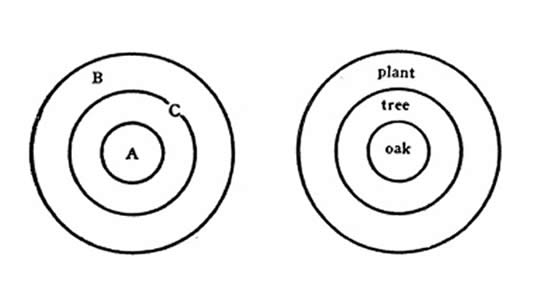
Now the roundabout or mediate process of arriving at judgment may be illustrated as follows: The mind compares ideas A and B, but because of their obscurity, finds immediate judgment impossible. However the mind sees that idea A agrees with idea C; it also sees that idea C agrees with idea B. Thus, by using idea C as the medium it arrives at the judgment “A agrees with B.” This is mediate inference; this is reasoning.
To illustrate further: Suppose the mind compares the two ideas oak and plant. Let it be further supposed that the ideas are obscure or vague, so that oak is associated in the mind chiefly with rugged sturdiness and strength, and plant with green and tender growth. The mind, comparing the two ideas, is not inclined to pronounce the judgment, “The oak is a plant.” Still, in spite of vagueness, there is in the idea oak the partly grasped note of growth. For this reason the mind is not inclined to enunciate the judgment, “The oak is not a plant.” Judgment is baulked; the mind cannot pronounce upon the agreement or disagreement of the two ideas. Suppose, however, that the mind knows clearly that the oak is a tree. Suppose further that it understands that all trees are plants. Thereupon, using as medium the idea tree, the mind can work out the judgment concerning oak and plant in the following manner: All trees are plants; the oak is a tree; therefore, the oak is a plant.
The two examples given may be graphically illustrated as follows:
From the foregoing we see that reasoning is a roundabout way of arriving at judgment. We also see that the judgment is worked out of two other judgments, thus:
All trees are plants
The oak is a tree
Therefore, the oak is a plant
The two judgments from which the judgment sought is worked out are called premisses. The judgment worked out is the consequent or conclusion. Notice that the conclusion is worked out of the premisses by the mind. It must therefore be in the premisses. From this we learn that the conclusion is nothing more than an explicit enunciation of what is implicitly contained in the premisses.
Analyzing the premisses we see that they involve three ideas. The mind seeks to pronounce judgment upon two ideas; for the purpose it calls in a third idea known in relation to the other two. Now the idea which the mind seeks to predicate of another is the major idea, and the idea about which predication is to be made is the minor idea. In other words, the mind in reasoning seeks to know whether one idea is or is not contained in the Extension of another idea as its inferior or subject. Technically, the mind seeks to know whether the minor idea is or is not included in the Extension of the major idea. The mind seeks to make a predication, to predicate the major of the minor idea, affirmatively or negatively. Therefore the major idea will always be the predicate of the conclusion, and the minor idea will always be the subject of the conclusion. In the illustration given above, the major idea is the idea plant; the minor idea is the idea oak, and judgment upon these ideas is rendered possible by using a middle idea viz., the idea tree.
Summing up, we find that the reasoning process involves three judgments and three ideas. The judgments are two premisses and a conclusion. The ideas are the major, middle, and minor ideas. In the next Chapter we shall learn that these elements of reasoning find respective expression in three propositions and three terms, which have the names here ascribed to the mental elements of reasoning, viz., premisses and conclusion; major, middle, and minor terms. b) DEFINITION OF REASONING
Since reasoning has as its elements three judgments and three ideas, we may define it on the basis of its ideas, and on that of its judgments:
1 Reasoning is an operation of the mind by which the agreement or disagreement of two ideas is inferred from their known relation to a common third idea.
- Reasoning is an operation of the mind by which a judgment is explicitly inferred from two other judgments in which it is implicitly contained.
A little study will show that the two definitions are identical in meaning. The first definition tells us that the thing to be accomplished by reasoning is the inference of “the agreement or disagreement of two ideas,” and this is judgment. The second definition simply tells us that judgment is sought.
c) Methods of Reasoning
The two methods of reasoning are inductive and deductive reasoning, and these are usually called simply Induction and Deduction.
- Induction reasons from individual and particular data to a general or universal conclusion. Thus if one experiments with a specimen of each of the known metals, and finds that every one of them is heavier than water taken in equal bulk, one must conclude: “All the known metals are heavier than water.” This is induction, and complete induction. Again, suppose one observes that various bodies, in all circumstances of time, place, temperature, etc., tend to fall towards the center of the earth. One may (although experiment has by no means been made with each and every existing body) assert as a conclusion: “All earthly bodies tend towards the center of the earth.” This is incomplete (but sufficient) induction. Again, suppose one performs the experiment reported as follows in a newspaper: “An English scientist hitched a fly to a tiny wagon, and discovered that it could pull seventy times its own weight over smooth surfaces.” If one concluded from such an experiment: “All flies can pull seventy times their own weight over smooth surfaces,” one would give evidence of incomplete and insufficient induction.
Induction is the only method available to the experimental sciences. Its conclusions are known as scientific facts and scientific laws. It is valid when complete (a thing hardly possible) and also when incomplete but sufficient, that is, when its conclusions are drawn from representative data, thoroughly and exhaustively investigated. Induction when incomplete and insufficient has no scientific value, although it may indicate to the investigator a line of experiment that will eventually result in valid and scientific conclusions. But induction, however valuable, is not of first importance in rational science. Dialectics is concerned with deduction, not with induction. In passing, however, let us notice that the two methods are not opposed, one to the other, but are supplementary. Deduction starts with a general or universal datum; and induction seeks to establish a universal truth so that particular truths can be deduced therefrom.
- Deduction reasons from the universal to the particular and individual. The example of mediate inference (reasoning) given above illustrates the fact. Let us repeat it here:
All trees are plants (a universal datum)
The oak is a tree
Therefore the oak is a plant (i. e., one kind of
plant—a particular datum).
Deduction proceeds from two important principles, called the Dictum de Omni and the Dictum de Nullo. These are:
i. Dictum de Omni: Whatever is affirmed of a class as a whole, is thereby affirmed of each and every member of that class. To illustrate:
All trees are plants (plant affirmed of whole
class tree)
The oak is a tree (member of the class)
The oak is a plant (plant affirmed of that mem
ber)
ii. Dictum de Nullo: Whatever is denied of a class as a whole, is thereby denied of each and every member of that class. To illustrate:
No tree is a spirit (spirit denied of whole class
tree)
The oak is a tree (member of the class)
The oak is not a spirit (spirit denied of that
member)
Deduction is the perfect method of reasoning. Its conclusions are, when rightly drawn, inevitable in view of the premisses.
Summary of the Chapter
In this Chapter we have learned what is meant by reasoning, and have marked a line of distinction between immediate inference and reasoning proper. We have noted the elements of the reasoning process as three ideas and three judgments, and have learned to name these elements accurately. We have defined reasoning, and have discussed its two methods.