Relative Properties of Propositions
Propositions considered in relation to one another: Opposition (contradiction, contrariety, subcontrariety, subalternity) displayed in the Logical Square; Equipollence; and Conversion — all as means of immediate inference.
Propositions are studied in their logical relations to one another through three topics. Opposition describes the logical relations between propositions with the same subject and predicate differing in quality or quantity: Contradiction (A vs. O; E vs. I — one is necessarily true, the other necessarily false); Contrariety (A vs. E — both cannot be simultaneously true, though both may be false); Subcontrariety (I vs. O — both may be true, but both cannot be false); Subalternity (A implies I; E implies O — if the universal subalternant is true the particular subalternate must be true, but not vice versa). These four relations are displayed in the classic Logical Square, with practical applications to debate. Equipollence identifies logically equivalent propositions differing only in number of negations, with rules for forming the equivalent of a contradictory, contrary, or subaltern. Conversion is an immediate inference transposing subject and predicate while preserving truth: A converts to I (accidentally), E to E and I to I (simply), while O cannot be directly converted — each explained by tracing the Extension of subject and predicate through the two governing rules.
Article 3. Relative Properties of Propositions
of Propositions a) Opposition b) Equipollence c) Conversion We have hitherto considered propositions in themselves. Now we are to consider them in relation to other propositions made up of the same terms. This consideration will show certain relative properties that exist among propositions, and these properties serve as a means of direct or immediate inference. By immediate inference through the relative properties of propositions we may conclude to other propositions, or to a knowledge of the truth or falsity of other propositions.
We are to study three relative properties of propositions. The first of these is opposition which exists between propositions that have the same subject and predicate, but which differ in quantity or quality or both. The second relative property is equipollence, or “equivalence,” which exists between two propositions that have the same subject and predicate and the same force of meaning (“equivalent propositions”) yet differ in the number of negations they contain. The third relative property is conversion which exists between a proposition and itself transposed (that is, subject and predicate having changed places), the truth of the proposition being conserved.
a) Opposition of Propositions
Opposition is a relative property which exists between two propositions that have the same subject and the same predicate but differ in quantity or quality or both. Example: “All men are wise”— “Some man is not wise.”
There can be no opposition without a basis of agreement; indeed, there can be no disagreement without agreement,—a point where divergence begins. Thus we cannot discern any opposition between the propositions, “The snow is deep” and “This book is tiresome.” These are simply independent and unrelated propositions. They are in no sense opposed. For opposition to exist between two propositions, these must have the same subject and the same predicate. Thus we see that there is opposition between these propositions: “The snow is deep” and “The snow is not deep.”
There are two kinds or types of opposition, viz., opposition properly so called, and opposition improperly so called. Of the first type we have two sorts, viz., contradiction and contrariety. Of the second type we have also two sorts: subcontrariety and subalternity. A word on each of these follows:
I. Contradiction exists between an affirmative and a negative proposition (which have the same subject and predicate) when one expresses precisely that which is requisite and sufficient to overthrow the other. Such propositions leave no middle ground between them; they exhaust the possibilities. Therefore we say: Of contradictories, one is necessarily true, the other necessarily false. Example: “Every man is wise”—“Some man is not wise.” These propositions cover the whole ground. Study will show that they verify the description and definition of contradictories, and that they justify the principle enunciated about the truth and falsity of such propositions.
-
Contrariety exists between a universal affirmative and a universal negative proposition, each having the same subject and predicate. Such propositions leave a middle ground between them. They do not exhaust the possibilities. Thus, although contraries are sweeping denials of each other, they are not in such complete and accurate opposition as contradictories. Examples: “Every man is wise”— “No man is wise.” The principle concerning truth and falsity here is: Of contraries, both cannot be simultaneously true, although both may be false.
-
Subcontrariety exists between two particular propositions, one affirmative and one negative, both of which have the same subject and predicate. Example: “Some man is wise”—“Some man is not wise.” Obviously, the “some man” need not be the same individual, and hence there is no proper opposition between the propositions. They have an opposition improperly so called. Yet such propositions have a definite relation, and of them we enunciate the following principle: Of subcontraries, both may be true, but both cannot be false. If it could be false that “some man is wise,” and also false that “some man is not wise”—then thought is annihilated.
-
Subalternity exists between a universal affirmative proposition and a particular affirmative having the same subject and predicate. It also exists between a universal negative proposition and a particular negative having the same subject and predicate. Examples: “Every man is wise”—“Some man is wise”; “No man is wise”—“Some man is not wise.” Here again the opposition is improper. Yet such propositions have a definite relation and we may enunciate a relative principle about them. First, however, we must name the subalterns: the universal proposition is called the subalternant and the particular proposition (which differs only in quantity from the universal proposition) is called the subalternate. The principle is: Of subalterns, the truth of the subalternant involves the truth of the subalternate, but not vice versa; and the falsity of the subalternate involves the falsity of the subalternant, but not vice versa. In other words,
if subalternant is true—subalternate must be
true;
if subalternate is true—subalternant may be
true or false;
if subalternate is false—subalternant is false;
if subalternant is false—subalternate may be
true or false.
Apply the principle in these examples:
subalternant: “Every man is wise”
subalternate: “Some man is wise”
subalternant: “All men are mortal”
subalternate: “Some men are mortal”
subalternant: “No man is a spirit”
subalternate: “Some man is not a spirit.”
All the principles enunciated above may be studied and justified in the “Logical Square” which graphically illustrates the opposition of propositions. We give the Logical Square here, reminding the student of the letter-symbols of propositions, viz., A-proposition is universal affirmative; E-proposition is universal negative; I-proposition is particular affirmative; O-proposition is particular negative:
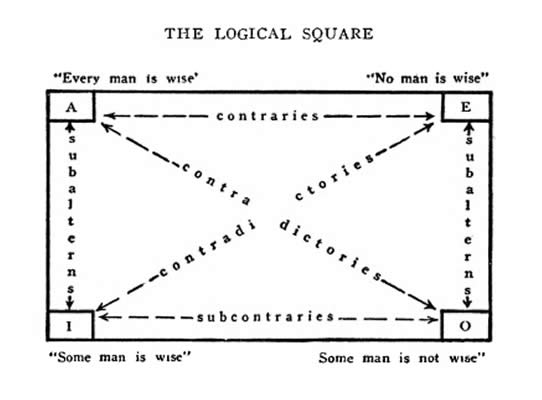
Principles
1. Of contradictories, one is necessarily true, the
other necessarily false.
2. Of contraries, both cannot be simultaneously
true, although both may be false.
3. Of subcontraries, both may be true; both cannot
be false.
4. Of subalterns, if the subalternant is true, the
subalternate must be true, but not vice versa;
and if the subalternate is false, the subalternant
must be false, but not vice versa.
NOTE: The practical value of opposition appears in argument or debate. From this relative property we gain important points of knowledge, such as: i. Not to make general and sweeping statements (A or E propositions), lest our whole argument be blown to pieces by the proof of the contradictory—a single opposed instance; 2. Not to try to prove the contrary of a general statement, but the contradictory. To try to prove the contrary would be mountainous labor, and even if we should succeed, the argument would not be settled, or “both contraries may be false.” Hence we see the justice of the adage: “He who proves too much, proves nothing”; z. To recognize the contradictory as the most valuable, and the thoroughly invincible argument; 4. To be on guard lest an opponent try to disprove our position by establishing the subcontrary, for “both subcontraries may be true.” 5. To avoid concluding to the truth of a subalternant from the truth of a subalternate, and to watch for this illogical proceeding on the part of an opponent.
The Logical Square also reveals Opposition of Propositions as a means of immediate inference. We can infer from any true A- or E-proposition the truth of its subalternate, the falsity of its contrary and contradictory. From any false I- or O-proposition we can infer the falsity of its subalternant and the truth of its contradictory. Let the student determine what can be inferred from any false A- or E-proposition, and from any true I- or ©-proposition.
b) Equipollence of Propositions
Equipollence (or “equivalence”) is the relative property existing between two propositions that have the same subject and predicate and mean the same thing, but which differ in point of one or more negations. Example: “All men are animals”—“No man is not an animal.”
The practical value of equipollence appears in the following facts: I. The study of equipollence makes for accuracy of thought and expression; 2. Sometimes a seeming denial may be shown by equipollence to be in reality an affirmation; 3. Equipollence affords a means of direct inference by which an obscure or vague proposition may often be expressed in clear and distinct form.
By equipollence, then, we infer the equivalent of a proposition or of its opposites from the proposition itself. To form the equivalent of the opposites, the following rules are to be followed:
-
To form the equivalent of the contradictory of any simple proposition, place a negative particle before the subject. “All men are wise”—“Not all men are wise.” “Not all men are wise” equals “Some men are not wise,” the contradictory of the original proposition.
-
To form the equivalent of the contrary of any simple proposition, place a negative particle before the predicate. “All men are wise”—“All men are not-wise.” The latter proposition equals, “No man is wise,” the contrary of the original proposition.
-
To form the equivalent of the subaltern (subalternant, if the original proposition is I- or O-; subalternate, if the original proposition is A- or E-), place a negative particle before both subject and predicate. “All men are wise”—“Not all men are not-wise.” The latter proposition equals, “Some man is wise,” the subalternate of the original A-proposition. Again, “Some man is not wise”—“Not some (i. e., any) man is not not-wise.” the latter proposition equals, “No man is wise,” the subalternant of the original O-proposition.
The equipollence of compound propositions need not be discussed in detail in this manual. As a general rule, let such propositions be reduced to the simple propositions that they contain, and equipollence be shown as indicated in the foregoing rules.
c) Conversion of Propositions
Conversion is that process by which one proposition is immediately inferred from another by transposing the subject and predicate and keeping the resultant proposition as true as the original proposition. The original proposition is called the convertend, and the resultant proposition is the converse. Between convertend and converse there exists, therefore, a definite relation, which we call the relative property of conversion. Example: “Lome man is wise”—“Some wise (being) is a man.”
Conversion is a very serviceable means of immediate inference. By its use the dialectician may draw true and valid propositions from other propositions. But there are rules that must be carefully followed, else this sort of immediate inference is unwarranted. The rules are:
-
The converse must be of the same quality as the convertend. This rule means: if the convertend is affirmative, the converse will be affirmative; and if the convertend is negative, the converse must be negative.
-
No term in the converse can have a wider Extension than it had in the convertend. Else the inference would be unwarranted as stating more than the proposition whence it was inferred.
-
Special rules: An E- or an I-proposition is converted simply, that is, E- will be converted to E-, and I- to I-. An A-proposition is converted accidentally, that is, A- will not convert to A-, but to I. An O-proposition cannot be converted directly. In other words:
A converts to I (accidental conversion)
E converts to E (simple conversion)
I converts to I (simple conversion)
O is not convertible
Let us study some examples of conversion. Suppose the A-proposition, “All men are wise” is to be converted. We first look at the terms of the proposition to make sure of their extension. “All men” is universal; “wise (beings)” is particular, being the predicate of an affirmative proposition. Therefore, when the proposition is converted we cannot make the subject “All wise beings” but “some wise beings.” Can we use “men” in a narrower, more re-tricted Extension in the converse than in the convertend? Yes, the rule forbids only the expanding of the Extension of terms. Certainly, if we have something stated as true of all men we may infer it as true of some men: for the principle is, “If a subalternant is true, the subalternate is true.” Now we proceed to the conversion of “All men are wise.” The converse is, “Some wise beings are men.” Notice that this justifies the dictum, “A converts to I.”
Take the E-proposition “No man is wise.” This is a negative proposition. Now in negative propositions the negation affects the copula, even if it be expressed in a particle prefixed to the subject. The accurate expression of “No man is wise” is “All men are-not wise.” Now examine the Extension of the terms of this proposition. The subject is universal; the predicate is also universal, being the predicate of a negative proposition. Therefore we may use both terms in full Extension (i. e., as universal terms) in the converse. We proceed to convert “No man is wise.” The converse is, “No wise (being) is a man.” Notice that this justifies the dictum, “E converts to E.”
Take the proposition “Some men are wise.” Both terms are particular: the subject, because it is qualified by the limiting “some”; and the predicate, because it is the predicate of an affirmative proposition. Therefore the converse will have both subject and predicate particular. And since the quality may not change, the converse will be a particular affirmative, that is, an I-proposition. Hence we see that “I converts to I.” The converse, therefore, of “Some men are wise” is “Some wise beings are men.”
Take the O-proposition “Some men are not wise.” The subject is particular, and the predicate—being predicate of a negative proposition—is universal or in full Extension. Now the converse will have to be negative by the first rule of conversion: “The converse must be of the same quality as the convertend,” Therefore when the particular “some men” becomes the predicate of the converse it will have to be changed to “all men.” But this conflicts with the second rule of conversion: “No term can have a wider Extension in the converse than it had in the convertend.” Therefore in the case of the O-proposition direct conversion is impossible.
Summary of the Article
In this Article we have learned what is meant by Opposition, Equipollence, and Conversion of propositions. We have learned these as properties of propositions and as processes of immediate inference. They are valuable processes of such inference, for they enable the dialectician to see the faulty and illogical nature of statements unwarrantedly made in virtue of other statements, and they equip him for the task of forming clear and valid inferences. Suppose the student, after mastering this Article, should hear a lecturer remark: “I have been for many months a close observer of the life of the Catholics of French Canada. These people are intensely religious. Yet their life is barren of those little comforts and conveniences that modern science has made available to us here in America. Can anyone, seeing this, doubt the well-known fact that the Catholic religion stands in spirit and in fact against the progress of science?” The words may be “boiled down” to the following: “French Canadian Catholics are unprogressive.” This proposition is then converted into “All Catholics are unprogressive.” The dialectician sees at once the point of fallacy in the whole argument: the speaker has inferred the truth of a subalternant from the truth of its subalternate,—an unwarranted procedure.
We have learned that Equipollence and Opposition of propositions also serve as means of inference and as “checks” or bases of criticism upon unwarranted inference. In all the matter studied in this Article there is much that can be put to practical use, much that makes for clear thinking, even though the student must pay for this service by hard study of dry rules and tedious explanations of principles.
Let the student put his knowledge to immediate service in daily reading of books and newspapers. He will be amazed at the number of instances of unwarranted inference he will discover. Let him in each instance reduce the inference to a proposition in logical form, and then criticize it according to the rules learned in this Article for the relative properties of propositions. He will find the work interesting. and he will be stirred to greater effort by the io consideration of the fact that the inferences he sees as unwarranted (and sees how and why and where they are illogical) convince a great many people— even educated people—who accept them as sound reasoning and correct thinking.