Logical Division
How ideas are explained by dividing them: the doctrine of Logical Division (its three elements — Principle, Totality, Dividing Members) and the four rules that govern a correct division.
Logical Division explains an idea by analysing its Extension — distributing the idea into its inferior ideas according to a governing Principle of Division. It is distinguished from Real Division (dividing a reality into its actual parts, physical or metaphysical) — Real Division looks to content, as Definition does, while Logical Division looks to Extension. Every division has three elements: the Totality Divided (the universal idea taken in extension), the Principle of Division (the aspect from which the division is made), and the Dividing Members (the resulting classes). Four rules govern valid division: only one Principle of Division throughout (no cross-division); the Dividing Members must jointly equal the Totality Divided (exhaustive); no single Dividing Member may be coextensive with the Totality Divided; and the Dividing Members must be properly arranged in coordination and subordination, illustrated by a worked example dividing 'Americans' down through continents, countries, states, counties, townships, and wards. A mnemonic jingle sums up the four rules.
Article 2. Logical Division
a) Doctrine of Logical Division B) Rules of Logical
Division
a) Doctrine of Logical Division
Logical Division is the orderly and systematic grouping or classification of the inferiors of a Universal. If one divides the inferiors of the Universal man thus: white men, red men, yellow men, black men, one has made a Logical Division.
Thus Logical Division explains ideas by exemplifying them in classes.
Logical Division differs from Real Division. Real Division is the division of a reality into its component parts. Real Division is physical when actual objective parts of a reality are distinguished; thus man is physically divided into body and soul; thus a tree is divided into trunk, roots, and branches. Real Division is metaphysical when it is the distinction of essential notes in an idea. Thus when the idea man is divided into the ideas rational and animal we have metaphysical division.
It will be seen from the above that Definition depends upon metaphysical division; for an idea must be analyzed or divided into its essential notes before these can be summed up in an essential definition. Thus Real Division looks (as does definition) to content; but Logical Division looks to Extension or application of an idea.
In every Logical Division three elements are distinguished:
i. The Principle of Division. This is the base, the aspect, the point of view, from which the division is made. If I divide “Looks” into Books on Theology, Books on Philosophy, Books on History, etc., the Principle of Division is “Nature of Contents.” If I divide “Books” into red books, blue books, green books, brown books, etc., the Principle of Division is “Color of Binding.” If I divide “Books” into Latin Books, Greek Books, Hebrew Books, German Books, English Books, etc., the Principle of Division is “Language in which books are written.”
-
A Totality Divided. This is a universal idea considered as applied in Extension. In examples given above, the “Totality Divided” is the Universal book taken in extension.
-
Dividing Members. These are the groups effected by the Logical Division. Thus if I divide the Universal man (taken in Extension as all human beings), into white men, black men, yellow men, red men, each of these classifications or groups is a “dividing member” of the Logical Division.
To illustrate the elements of Logical Division:
1. Totality Divided: man
2. Principle of Division: race
3. Dividing Members: men of the white race,
men of the black race, men of the yellow race,
men of the red race.
b) Rules of Logical Division
Logical Division, like Definition, is a means of clarifying ideas (and terms). Now if it be not regular, consistent, systematic, and complete, it will defeat its purpose, and will only muddle and obscure idea (terms) instead of clarifying them. Hence the following rules must be carefully learned and faithfully observed. The reason for each rule will be made apparent by examples.
Rule I. In each Logical Division there must be only
one Principle of Division
If there is a shift of base, a change of principle, the Division cannot be otherwise than confusing; hence it will be rather a hindrance than a help in the matter of clarifying ideas. The following example offends against this rule:
Totality Divided: Americans
Principle of Division: Religion
Dividing Members: Catholics, Protestants,
Democrats, Quakers, etc.
Rule II. The sum of The Dividing Members must
equal The Totality Divided
This rule means that the Division must be complete—no Dividing Members omitted. If the rule is not observed, the Division can serve no purpose of clarifying, for it will lack definiteness because it is incomplete. The following example of Division offends against this rule:
Totality Divided: chairs
Principle of Division: service
Dividing Members: Useful chairs, ornamental
chairs.
The list of Dividing Members is incomplete; for there are chairs which serve neither use nor ornament.
Rule III. Let no single Dividing Member be Co
extensive with The Totality Divided
To propose as a Dividing Member what is equal in Extension with the Totality Divided is to fail to divide; hence, in such instances, the supposed Logical Division is inane and useless. The following example offends against this rule:
Totality Divided: Animals
Principle of Division: Cognitive capacity
Dividing Members: Sentient animals, rational
animals.
Notice that “sentient animals” is not a proper classification or group of animals, for all animals are sentient.
Rule IV. The Dividing Members must be properly
arranged
To fail in proper arrangement—coordination and subordination—of Dividing Members is to make the Division a confusing jumble, and hence to defeat its purpose, which is to clarify. The following Division offends against this rule:
Totality Divided: Americans
Principle of Division: Place of Residence
Dividing Members: North Americans, South
Americans, Central Americans, Mexicans.
“Mexicans,” a national group, should not be coordinated with the continental groups. Its place is one of subordination to “North Americans.”
The following is a correct Logical Division:
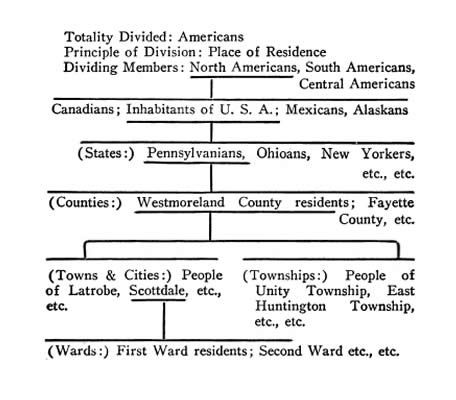
Totality Divided: Americans
Principle of Division: Place of Residence
Dividing Members: North Americans, South Americans,
“” Central Americans Canadians; Inhabitants of U. S. A.; Mexicans, Alaskans
(States:) Pennsylvanians, Ohioans, New Yorkers,
etc., etc. (Counties:) Westmoreland County residents; Fayette
County, etc.
(Towns & Cities:) People (Townships:) People of of Latrobe, Scottdale, etc., Unity Township, East etc. Huntington Township,
etc., etc.
(Wards:) First Ward residents; Second Ward etc., etc.
The Rules of Logical Division are summed up in the following jingles
One principle; all members call;
And let no member equal all;
Arrange—with due deliberation—
Coordinate subordination.
Summary of the Article
In this Article we have learned what is meant by Logical Division. We have contrasted Logical with Real Division, physical and metaphysical. We have learned the use of Logical Division, studying its essential elements, and exemplifying the rules which must be observed in order to make Logical Division serve its purpose of clarifying ideas (or terms).